

A Case for Nepo Babies in the Art World
The recently coined term ‘nepo baby’ denotes someone whose success comes from powerful family ties, influence, and wealth, rather than genuine talent and skills. It has gained a very negative connotation, particularly in the entertainment and fashion industries.
Even though these industries are often seen as adjacent to art and oftentimes intersect with it, there is a case to be made in support of nepo babies in the art world. Art history would have never been the same if it were not for a couple of outstanding nepo babies we all know and revere. After all, wealth and privilege may not produce artistic talent, but they can produce the conditions in which artistic talent is allowed to flourish and thrive.
1. First, Cosimo de’ Medici. The son of Giovanni di Bicci de’ Medici, who founded the Medici Bank in 1397 and made the Medici one of the wealthiest European families in the fifteenth century, Cosimo grew up with the means and access to support great artists. He befriended not just Donatello but many of his contemporaries, later funding the renovation and reconstruction of the Duomo, the Convent of San Marco, and Santa Croce, among others. He also patronised the most illustrious scholars of his time, providing intellectuals like Marsilio Ficino with both housing and a stipend, resulting in the translation of Plato’s complete works from Greek into Latin for the first time.
Cosimo’s grandson, Lorenzo the Magnificent, went even further. Not as interested in the family business, Lorenzo dedicated himself to state affairs and artistic patronage. Mere metres from his family home, he founded a Sculpture Garden, which doubled as a school for young artists, Michelangelo Buonarroti included. But he was hardly the only prodigy there. It was upon Lorenzo’s instruction that Sandro Botticelli was dispatched to Rome to paint frescoes on the walls of the newly built Sistine Chapel in the Vatican. It was also upon his counsel that Leonardo da Vinci was sent to Milan to the court of Ludovico Sforza, becoming the first example of an artist himself being a cultural export.
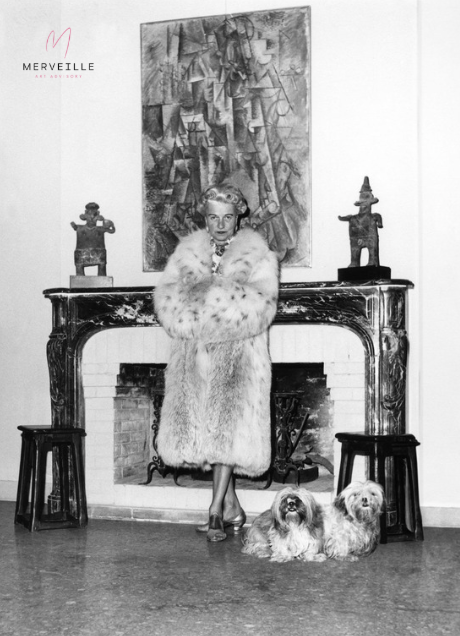
2. Second, but no less vital in her time, is Peggy Guggenheim. Heiress to a prominent mining fortune, Peggy was hardly a stranger to the art world: her uncle, Solomon R. Guggenheim, was a major collector in his own right and founded the Guggenheim Museum. But Peggy went a step further. She lived and breathed art: she was a serial collector, a muse, a dealer and a patron.
In 1938, Peggy opened her first gallery in London, where she set out to exhibit her European friends, whom she knew and collected personally, including Jean Arp, Wassily Kandinsky, and Constantin Brancusi, as well as her two lovers: Max Ernst and Yves Tanguy. She even exhibited works by schoolchildren, among them the future great artist Lucian Freud. The outbreak of the Second World War, however, cut her plans short. She initially moved to Paris, where she continued to obsessively collect art, adhering to her motto, “buy a picture a day”. In 1941, because she was Jewish, Ms Guggenheim had to flee Europe for New York, shipping her collection along with her because the Louvre infamously refused to store it (a decision they have surely come to regret. However, everything always works out for the best, because judging by their repeated security breaches and robberies, Peggy’s collection might not have been safe there anyway).
In New York, Peggy set up the gallery Art of This Century in 1942, where she championed the American avant-garde, partially due to her growing detachment from her European Surrealist friends following her divorce from the artist Max Ernst.
Peggy Guggenheim was instrumental in putting Abstract Expressionist artists on the map, staging early solo shows by artists including Jackson Pollock, Robert Motherwell, and Clyfford Still, and supporting a generation of American avant-garde artists. Her patronage also went well beyond simply hanging their works on gallery walls. She paid artists stipends, bought their unsold inventory, and aided in procuring institutional support for them. Her inherited wealth undoubtedly gave her the ability to take risks that other dealers could not. Crucially, however, she actually took them. Money gave Peggy access to the art world; taste, instinct, and an almost obsessive commitment to artists determined what she did once she got there.
In 1947, Peggy departed from the US once again and relocated to Venice, buying Palazzo Venier dei Leoni on the Grand Canal, where she lived until the end of her days in 1979. The palazzo now houses her collection as the Peggy Guggenheim Collection and remains one of the most visited museums in Venice – a true testament to her vision and legacy.
3. The list goes on. Take Abby Aldrich Rockefeller, who came from the wealthy Aldrich family herself before marrying into the even wealthier Rockefeller family. An avid collector of modern art, she went on to co-found the Museum of Modern Art in New York in 1929, an institution that fundamentally changed how modern art was collected, exhibited, and understood in the United States.
There was also Dominique de Menil, heiress to the Schlumberger oil-services fortune and an avid modern art collector. Together with her husband, John de Menil, she amassed an extraordinary collection and supported artists, museums, and cultural organisations throughout her lifetime. The couple ultimately left behind a phenomenal institution in Houston called the Menil Collection. It houses masterpieces of Modern and Contemporary Art, from Magritte to Warhol and beyond. Once again, private wealth was transformed into something positively public: an institution through which generations of visitors could encounter works that might otherwise have remained behind the closed doors of private collections.
And the most recent example of the continuity of art patronage among nepo babies is Alice Walton, daughter of Sam Walton, founder of Walmart. She used her inheritance to found the Crystal Bridges Museum of American Art in Bentonville, Arkansas. The choice of location was not accidental – rather than adding another major collection to New York or another established cultural centre, the aim was to bring access to world-class art to a historically more underserved area of the United States. Alice is also one of the biggest buyers of American art in the world, having paid record prices for works by Georgia O’Keeffe, Norman Rockwell and others, with her collection exceeding three thousand works to date.
The best of the art world’s nepo babies understood that privilege could be spent on more than themselves. They converted private fortunes into studios, stipends, commissions, collections and, eventually, public institutions. They gave artists the luxury of time, provided audiences for work that had not yet been accepted, and occasionally gambled extraordinary sums on ideas that the rest of the world had not yet learned to value.
So, next time anyone around you decides to lament nepo babies’ life choices, remind them that without nepo babies, our cultural life and artistic heritage could have looked very different. We might have had fewer museums, fewer masterpieces and, in some cases, fewer opportunities for the artists we now consider geniuses to become geniuses in the first place. Nepotism may be difficult to defend, but if one is unfortunate enough to inherit a vast fortune, funding the next Michelangelo is surely one of the better things to do with it.
